
AI without losing the personal touch7 min read
Can AI Answer Your Coaching Clients' Messages? Only as Drafts
Disclosure: we make Grytt, one of the tools here. Sources are at the end, and there's a section on when Grytt is the wrong choice.
Contents
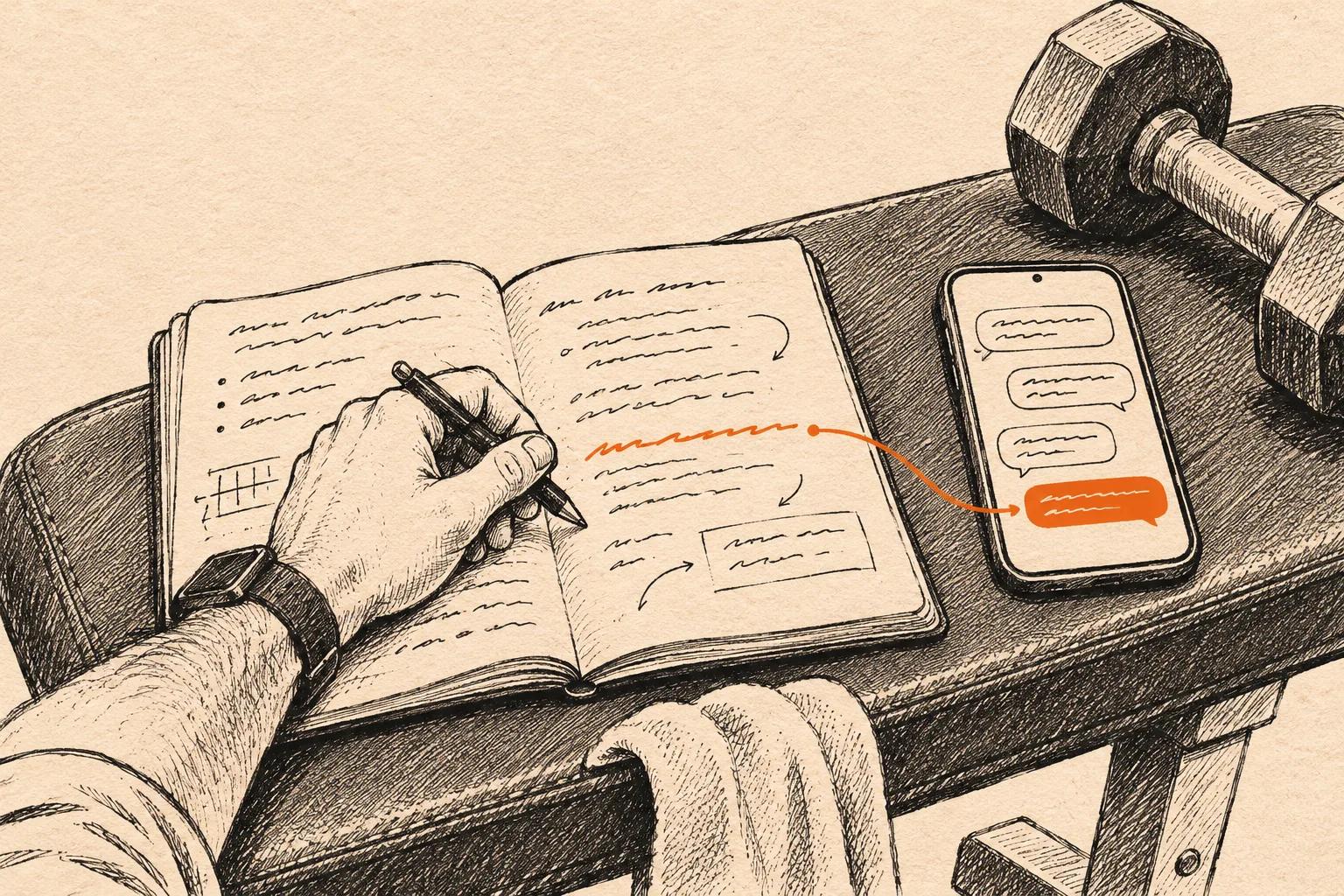
Yes, AI can answer your coaching clients' messages, as long as it writes a draft that you check and send. It shouldn't send anything on its own, and it should never draft a reply about pain, illness, eating or distress.
Most AI reply tools learn how you sound. Very few learn what you'd actually say, and that's the difference clients notice. Below: which apps draft replies today, why tone isn't enough, a methodology template you can fill in this week, and the messages AI should never touch.
Which apps draft replies to coaching clients?
Several coaching apps now draft replies for you to approve. They differ in what they learn from: a tone setting, your past replies, or rules you write down. Checked on 20 November 2026, from each company's own pages.
| Tool | What it learns from | You approve first? | Risky messages |
|---|---|---|---|
| Grytt (Co-pilot) | Your written methodology (rules, preferences, philosophy, Q&As, protocols) and notes on each client | Yes. Every reply is a draft today | Pain, injury, illness, eating and distress go to you with no draft |
| MacroActive (COACH.) | Written instructions that shape tone and behaviour | Yes: "Nothing sends until you send it" | Not stated |
| Assistant Coach | Check-in data, history and "your coaching style" (how isn't stated) | Yes, you edit and send | Flags red flags in check-ins |
| Everfit (AI Smart Response) | A tone you pick (formal, casual, excited), your FAQ and saved replies | Yes, drafts only | Not stated |
| My PT Hub (Check-Ins AI) | Check-in data; says replies "look and feel exactly like you" | Not stated on its pages | Not stated |
Trainerize doesn't have a built-in reply drafter on its own pages. Its blog suggests pasting messages into "your AI tool of choice". Kahunas' AI, Crew, drafts programs and meal plans but can't message clients.
Why do tone-matched drafts still sound wrong? Voice isn't method
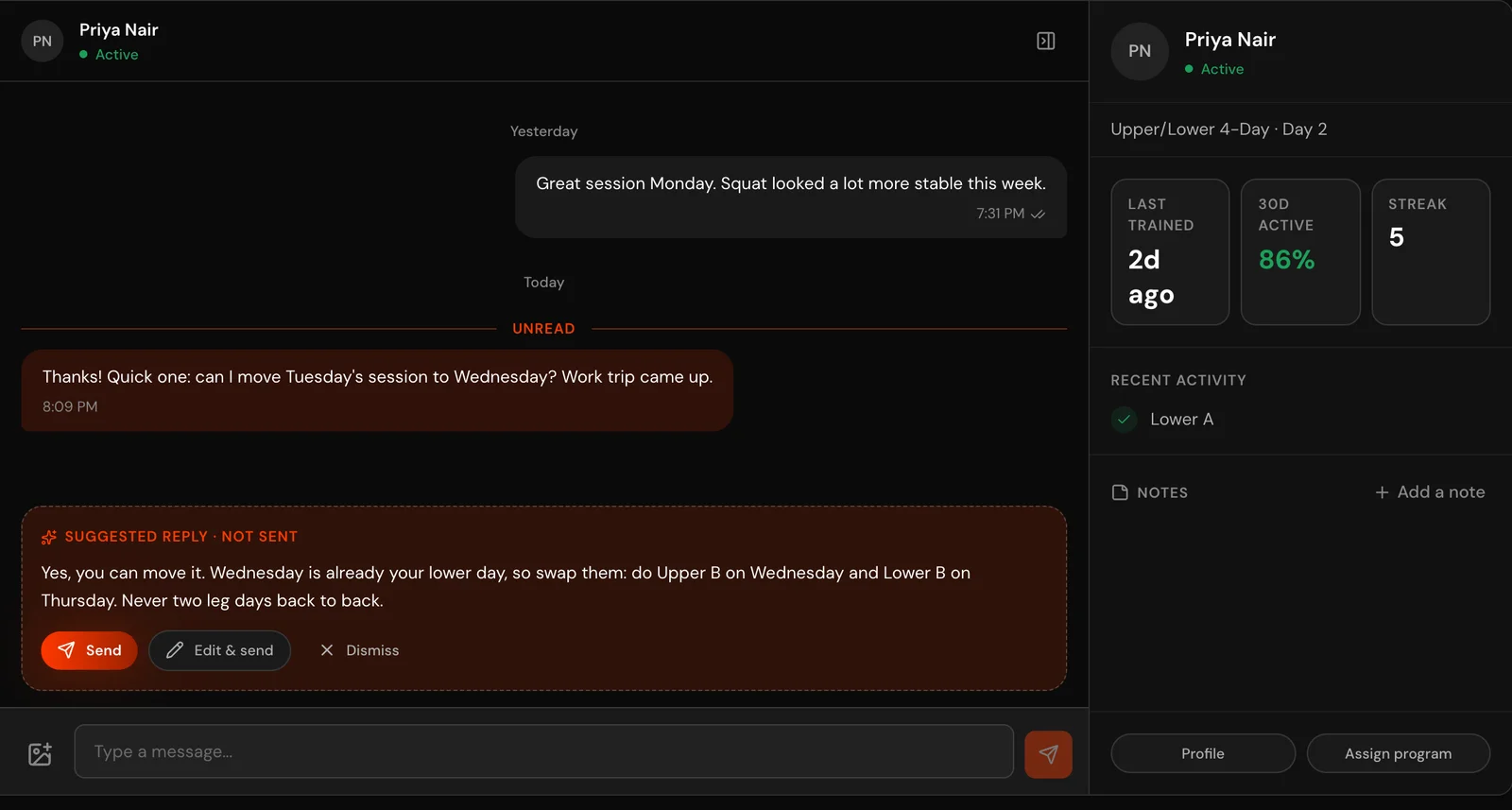
A draft can sound exactly like you and still give the wrong answer. Tone covers how you say things. Your methodology covers what you'd say, and clients notice the second one.
Take two messages and two drafts:
- "Can I move Tuesday's session to Wednesday?" A tone-matched draft says "Of course, flexibility is key!" Your rule says never two lower-body days back to back, and Wednesday is already legs.
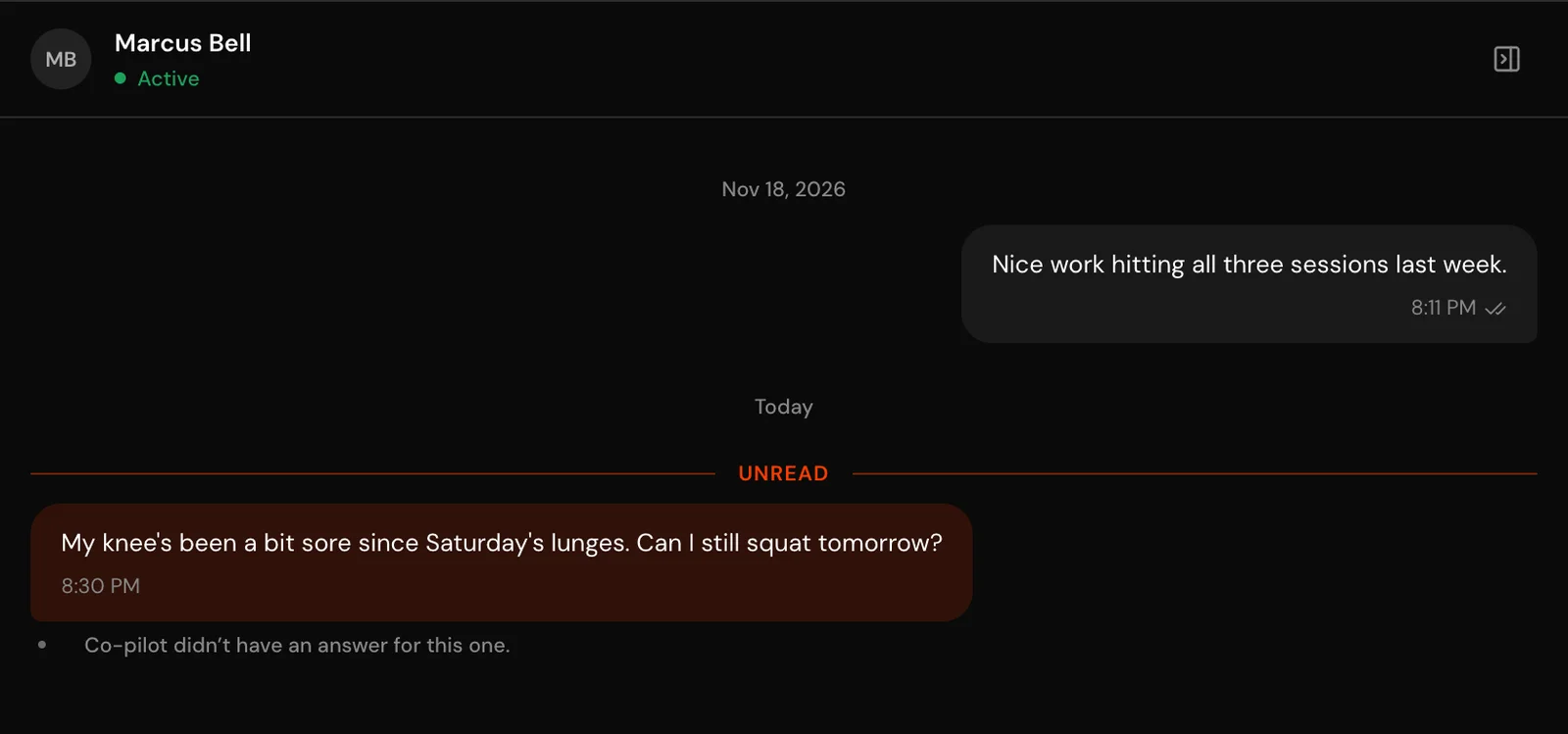
- "My knee's a bit sore, can I still squat tomorrow?" A tone-matched draft says "Listen to your body and go lighter!" That message shouldn't get a draft at all. It needs you.
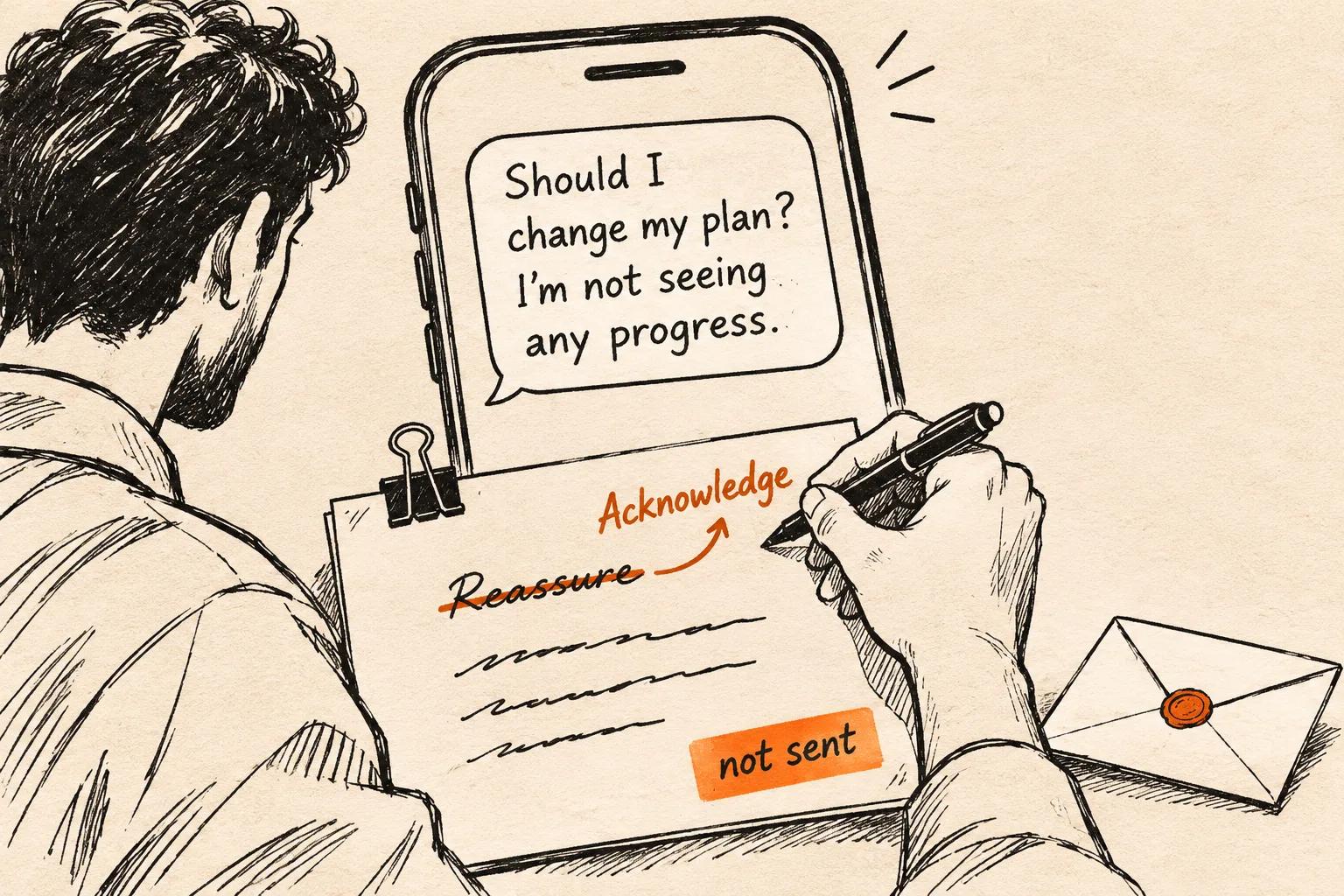
When we described an early version to a coach as "AI that coaches on your behalf", they turned it down flat. They were right. Nobody wants software coaching their clients. They want help with the typing, for the answers they'd have given anyway.
How do you write a methodology an AI can follow?
Write down the five things you already know but have never typed out: your rules, your preferences, your philosophy, your answers to common questions, and your default programs. An AI can only follow what's written.
- Rules: what you always or never do. "Never two lower-body days in a row." "Never cut calories by more than 10% in one week."
- Preferences: what you'd pick when there's a choice. "Goblet squats over back squats when a client is travelling." "Walks before cardio machines for fat loss."
- Philosophy: what you believe, in one line each. "Consistency beats intensity in the first 8 weeks." "A missed session is data, not a failure."
- Q&As: real questions, with your real answers. "Can I have a cheat meal?" followed by exactly what you told the last client who asked.
- Protocols: your default program for each client type. "Busy parent, 3 days: full body A/B, 45 minutes, no session over 6 exercises."
The examples above are ours, to show the format. Use yours.
The fastest way to start: open last month's messages, find the 20 questions you answered most, and copy your real replies into the Q&A section. That alone covers the questions you get most. Replies are only one part of a coach's week; here's how the rest adds up.
No tool yet? The same method works in ChatGPT or Claude. Remove the client's name first, and only paste what your client has agreed to share.
You draft replies for an online fitness coach. The coach reads and edits
every draft before sending. Use ONLY the methodology below. If it doesn't
cover the question, write "COACH TO REPLY" and stop.
Never draft a reply about pain, injury, illness, medication, food or body-image
worries, or distress. For those, write "COACH TO REPLY" and stop.

Methodology:
RULES: [paste]
PREFERENCES: [paste]
PHILOSOPHY: [paste]
Q&As: [paste]
PROTOCOLS: [paste]

Client's message:
[paste]

Write the reply in 2 to 4 short sentences, in the coach's voice.
Which messages should AI never draft?
AI should never draft a reply about pain or injury, illness or medication, worries about food or body image, or signs of distress. Those need your judgement, and sometimes a professional's, not a faster reply.
- Pain or injury: "My knee's sore", "my back went during deadlifts".
- Illness or medication: "I've been put on new tablets", "I've had a fever all week".
- Food and body image: skipping meals, guilt after eating, fear of weight gain.
- Distress: low mood, stress, anything that sounds bigger than training.
Add anything you'd want to say on a call: a cancellation, a complaint, a client saying they want to stop. The same list applies when AI reviews check-ins.
Grytt's Co-pilot works this way. A message on any of these topics gets no draft, just a line saying Co-pilot didn't have an answer, so the reply always comes from you.
When isn't Grytt the right fit?
We'd rather you pick the right tool than the wrong one from us. Pick something else if:
- You want AI drafting today, without an invite. Grytt's Co-pilot is in early access on Plus and Pro, not the free plan. Everfit and MacroActive are available now.
- You want replies sent automatically. Grytt drafts every reply for you to send. If you want auto-send, Grytt isn't built for it.
- You don't want to write your methodology down. Grytt's drafts are only as good as what you teach it. A tone-only tool needs less setup.
- You want payments in the same app. Grytt doesn't have them yet.
Frequently asked questions
Can AI answer my coaching clients' messages?
AI can draft replies for you to check and send. It shouldn't send on its own, and it should never draft replies about pain, illness, eating or distress.
How do I get AI to reply in my coaching style?
Give it your rules, preferences, philosophy, real questions with your real answers, and your default programs by client type. Tone settings alone copy how you sound, not what you'd say.
Is there AI that programs in my coaching style?
Yes. Some coaching apps, including Grytt's AI Builder, draft programs from protocols you write once per client type. You review the draft before the client sees it.
Will clients know the reply was drafted by AI?
They notice generic replies, not drafted ones. A draft that uses your rules and mentions their actual week reads like you, especially after your edit.
Is it safe to paste client messages into ChatGPT?
Only with the client's consent and without their name or other identifying details. Messages often hold health information, so treat them like medical notes.
The bottom line
Every tool here can make a reply sound like you. The useful ones also know what you'd say, and know when to stay quiet and hand the message back.
The goal was never AI that coaches for you. It's AI that types for you, so you can keep coaching.
If that's how you want to handle messages, start Grytt free for your first 10 clients. Co-pilot is in early access on Plus and Pro. For prices across the main coaching apps, see our software comparison.
Sources
Checked on 20 November 2026. AI features change fast, so check each tool's page before you buy.
- MacroActive: 1:1 Check-In Agent
- Assistant Coach: website, PeerPush listing
- Everfit: AI Smart Response
- My PT Hub: AI tools article
- Kahunas: Crew
- Trainerize: client check-in system
- Grytt: pricing

Written by
Online coach, Grytt team
Aromal Das is an online fitness coach and part of the Grytt team. He coaches clients online and writes about the tools and habits that make online coaching work.